Getting the choice right isn't complicated. But it does require knowing what to look for in the size, the MERV rating, and the replacement schedule — especially in a home where a child under five breathes this air every day.
TL;DR Quick Answers
20x25x1 HVAC Home Air Filter
The 20x25x1 is one of the most common residential HVAC filter sizes, fitting standard return air slots in forced-air furnaces and central air conditioning systems. Here's what to know before buying:
Actual dimensions run slightly smaller than the nominal label — typically 19.5 x 24.5 x 0.75 inches. Measure your slot or check the size printed on your current filter before ordering.
MERV 8 is the recommended starting point for most homes. It captures dust, pollen, mold spores, and pet dander without restricting airflow in standard residential systems.
MERV 11 is the better choice for homes with young children, allergy sufferers, or pets. It adds capture efficiency for finer particulates including dust mite debris and smaller mold spores.
Avoid MERV 13+ in standard residential systems unless your HVAC manufacturer specifically rates the equipment for that level of airflow resistance.
Replace every 60 to 90 days in most homes. Homes with young children, pets, or allergy sufferers should change the filter every 30 to 45 days.
Frame fit matters as much as MERV rating. A filter that sits loosely in the slot allows unfiltered air to bypass the media entirely — negating the rating on the label.
Top Takeaways
The 20x25x1 is a nominal size, not a guarantee of fit. Confirm your actual slot dimensions before ordering. A loose filter allows unfiltered air to bypass the media regardless of what's printed on the label.
MERV 8 is the minimum for homes with young children. It captures dust, pollen, mold spores, and pet dander without restricting airflow in standard residential systems. Step up to MERV 11 for nurseries or children under 5 with respiratory sensitivities.
Young children breathe faster and stay at floor level. Their higher breathing rates and floor-level activity increase their exposure to disturbed dust, making consistent filtration especially important in homes with infants and toddlers.
The frame seal is as important as the MERV rating. A rigid frame that seats flush against all four slot edges is essential. Any gap creates bypass, and bypass means the filter isn't doing its job regardless of its rating.
Replace every 30 to 45 days in homes with young children. Standard 60 to 90-day guidance doesn't account for the higher particulate load in homes with active children. A loaded filter restricts airflow and progressively loses capture efficiency.
A MERV 8 changed every 30 days outperforms a MERV 13 changed every six months. The schedule matters as much as the rating. Consistent replacement is the habit that makes the filter work.
Why the 20x25x1 Filter Size Matters for Your HVAC System
The 20x25x1 refers to a filter's nominal dimensions: 20 inches wide, 25 inches tall, 1 inch thick. It's one of the most widely used residential HVAC filter sizes in the country, designed for standard return air slots in forced-air furnaces and central air conditioning systems. What the nominal size doesn't tell you is the actual size, which typically runs slightly smaller at around 19.5 x 24.5 x 0.75 inches. Before ordering, confirm your slot's measurement either by reading the size printed on your current filter or measuring the opening directly.
Fit matters more than most homeowners realize. A filter that sits loosely creates gaps between the frame and slot edges, and air takes the path of least resistance. Unfiltered air bypasses the media entirely and circulates through the home without capturing a single particle. In a home with young children, that bypass defeats the purpose of having a filter. The right 20x25x1 air filter sits flush against all four sides of the slot, so every cubic foot of air the system moves passes through the media where it belongs.
Look for rigid frame construction. Cardboard or beverage board frames hold their shape when inserted. Thin or flexible frames compress, bow, and create the exact bypass gaps you're trying to avoid. A firm, consistent seal matters at least as much as the MERV rating on the label.
Understanding MERV Ratings and Dust Capture for Young Children
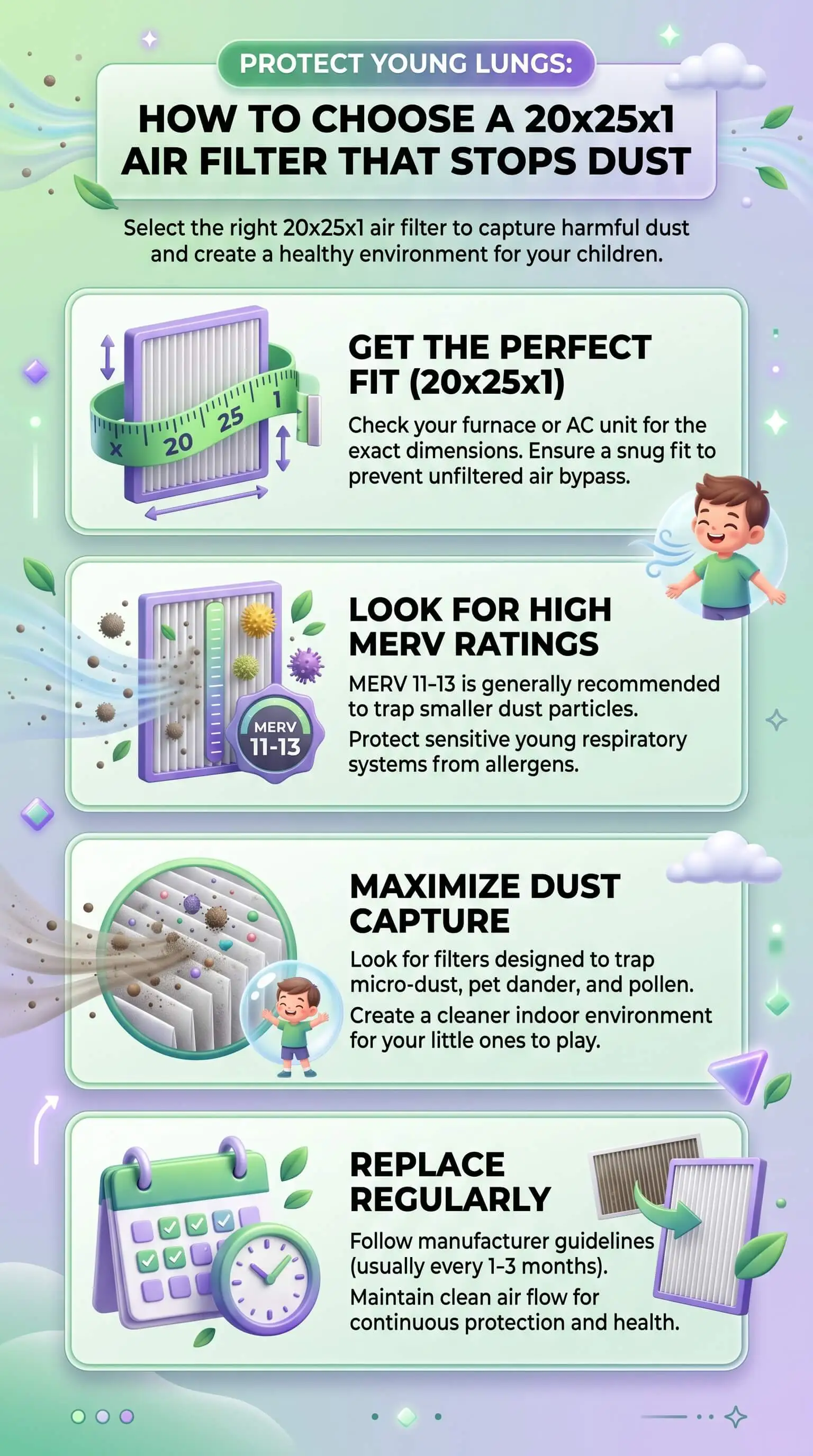
MERV stands for Minimum Efficiency Reporting Value. A MERV rating chart measures a filter's ability to capture airborne particles across a range of sizes, from large dust and pollen down to fine particulate matter. The scale runs from MERV 1 to MERV 20. For residential homes with young children, the practical range sits between MERV 8 and MERV 11.
MERV 8 is where most families with children should start. It captures at least 70 percent of particles in the 3 to 10 micron range — larger dust, pollen, mold spores, and pet dander. Most standard residential HVAC systems handle MERV 8 without any airflow restriction, and it delivers meaningful dust reduction across the whole living space.
MERV 11 adds capture efficiency for smaller particles: fine dust, smaller mold spores, and dust mite debris. Those allergens matter especially in homes with crawling infants or toddlers who stir settled dust with every move. For nurseries or any child under five with a documented respiratory sensitivity, MERV 11 is the stronger choice.
One thing worth knowing plainly: MERV 13 and higher use denser filter media that creates greater airflow resistance. Many residential HVAC systems aren't built to handle that level. Pushing a high-MERV filter into a system rated for lower pressure can reduce airflow efficiency, strain the blower motor, and over time actually worsen indoor air quality. Unless your system's documentation specifically supports MERV 13 or higher, MERV 8 to 11 is the right range for most homes with young children.
How Dust Affects Developing Respiratory Systems
Young children aren't simply small adults when it comes to indoor air exposure. Their lungs are still developing. They breathe significantly faster than adults do. A newborn cycles air 30 to 60 times per minute, compared to 12 to 20 times for most adults — which means an infant in a dusty room moves far more airborne particulate through developing lung tissue in the same hour than any adult sharing that space would, which is why high efficiency air filters matter in those environments.
There's also the floor problem. Crawling, sitting, and playing near the ground puts children directly in the air layer where settled dust is most easily disturbed. Every adult footstep, every vent draft, and every pet crossing the room kicks fine particles back into suspension. Those particles stay airborne for extended periods before the filter system draws them back through on the next air cycle. By then, a child at floor level has already breathed through the worst of it.
The particle types that matter most in homes with young children are fine particulate matter (PM2.5), dust mite allergen, mold spores, and pet dander. A MERV 8 to 11 filter captures meaningful quantities of all four. It won't eliminate them entirely — no single filter does — but it measurably reduces airborne concentrations with every cycle the HVAC system completes.
What to Look for When Buying a 20x25x1 Air Filter
Four things determine whether a 20x25x1 HVAC home air filter actually protects your family's air or just occupies the slot.
Correct nominal dimensions. Confirm the 20x25x1 matches the printed size on your current filter or the label on your HVAC slot before ordering. Don't estimate.
MERV 8 to 11 rating. MERV 8 handles most homes with children. Step up to MERV 11 for nurseries or homes where a child under five has respiratory sensitivities. Avoid MERV 13+ in standard residential systems.
Rigid frame construction. Look for a firm cardboard or beverage board frame that holds its shape on insertion. Thin or flexible frames compress and create bypass gaps that let unfiltered air pass around the media.
U.S. manufacturing standards. Filters made in the United States follow consistent quality standards across every production run. Our teams have found that frame seal consistency and media uniformity batch-to-batch are what separate a filter that performs reliably in the home from one that only tests well in a lab.
How Often Should You Change a 20x25x1 Filter With Young Children at Home?
The standard filter replacement guideline for most homes is every 60 to 90 days. That guidance wasn't written for homes with young children.
In homes with children under 5, change the filter every 30 to 45 days. Young children disturb settled floor dust constantly, increasing the volume of airborne particulates the system has to process. They add contaminant load through outdoor tracking, food particles, and higher indoor humidity from bathing and normal breathing. And a loaded filter doesn't fail gracefully — it restricts airflow progressively until the system is working harder while capturing less of what it needs to catch.
The simplest check: pull the filter once a month and hold it to the light. Grey and dense means replace it. Still close to white means you have a little more time, but not much. A recurring phone reminder on the first of each month is the most reliable system most families actually stick to.
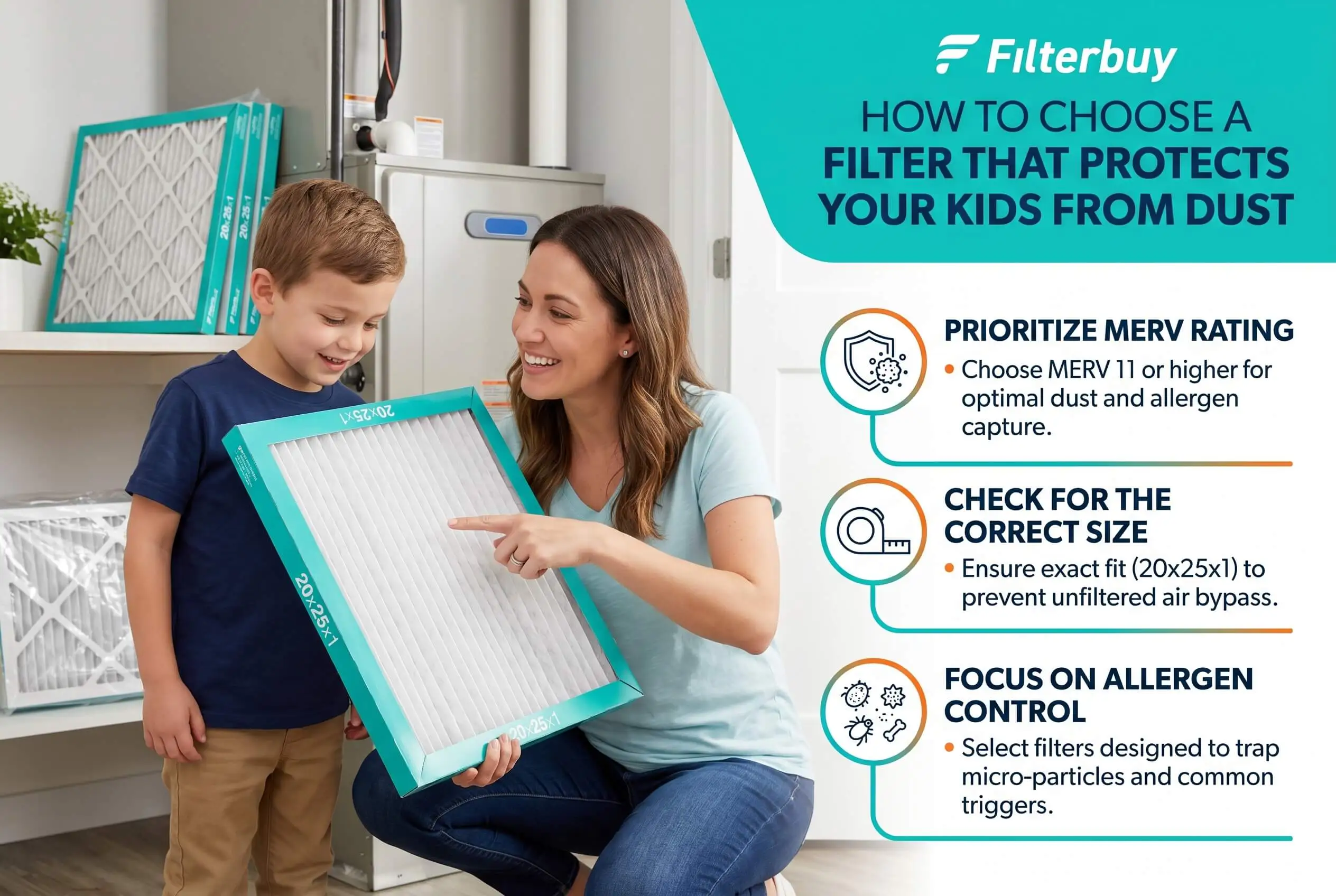
"One thing we see consistently in our manufacturing process is that parents with young children at home come back to us faster — often in four to six weeks rather than three months. When we looked at why, it wasn't a filter quality issue. It was the increased particle load in homes with crawling infants and active toddlers. The filter is doing exactly what it should. Those homes just need a shorter replacement cycle than the standard guidance suggests."
7 Essential Resources
Reliable guidance on indoor air quality and filter selection starts with verified sources. Each resource below comes from a government agency or established health organization and addresses a specific dimension of the 20x25x1 filter decision for homes with young children.
1. The EPA's Homeowner Guide to Indoor Air Quality
The EPA's Inside Story covers the primary pollutant categories found in residential homes — dust, biological contaminants, and combustion byproducts — and explains how ventilation and filtration work together to reduce indoor concentrations. It's a practical framework for any parent who wants to evaluate air quality risk room by room and make informed decisions about the home's filtration setup.
Source: https://www.epa.gov/indoor-air-quality-iaq/inside-story-guide-indoor-air-quality
2. EPA Guidance on Air Cleaners and Air Filters in the Home
This EPA resource explains how mechanical air filters work within residential HVAC systems, covers the MERV scale, and draws a clear line between air cleaners and filtration systems. Before selecting a MERV rating in a home with young children, this page helps you understand what a filter can reasonably do and what it can't.
Source: https://www.epa.gov/indoor-air-quality-iaq/air-cleaners-and-air-filters-home
3. American Lung Association: Clean Air Indoors
The American Lung Association's clean air resource covers the health implications of indoor pollutants including dust mite allergens, mold spores, and fine particulate matter. It provides accessible guidance for families managing asthma and respiratory sensitivities, with practical steps that work alongside consistent filter replacement.
Source: https://www.lung.org/clean-air/indoor-air
4. Energy Star: How to Keep Your HVAC System Working Efficiently
Energy Star's HVAC maintenance guide walks homeowners through the monthly filter check that prevents the most common efficiency problem: a loaded filter restricting airflow. It explains how a dirty filter increases energy costs, contributes to equipment wear, and steadily reduces the system's ability to condition and filter air.
Source: https://www.energystar.gov/products/ask-the-experts/how-keep-your-hvac-system-working-efficiently
5. EPA: Why Indoor Air Quality Is Important to Schools
The EPA's school IAQ resource offers one of the clearest government-published explanations of why children are disproportionately affected by indoor pollutants. It notes explicitly that children breathe more air in proportion to their body weight than adults do, and it identifies the particle types most harmful to developing respiratory systems — data that translates directly to the residential context.
Source: https://www.epa.gov/iaq-schools/why-indoor-air-quality-important-schools
6. NIH: Air Quality and Respiratory Health in Children
This peer-reviewed study published through the National Institutes of Health details the physiological reasons young children are uniquely vulnerable to airborne particulates. It covers higher baseline breathing rates, the developmental vulnerability of immature lungs, and the increased oral breathing patterns that allow pollutants to reach deeper into the lower respiratory tract than they would in an adult.
Source: https://pmc.ncbi.nlm.nih.gov/articles/PMC10292770/
7. CDC: Most Recent National Asthma Data
The CDC's asthma data resource publishes current national and state-level prevalence figures for asthma among children and adults, drawn from ongoing national surveillance systems. For parents navigating filter decisions in a home where a child shows any respiratory sensitivity, this resource puts the scale of pediatric respiratory disease in concrete, sourced terms.
Source: https://www.cdc.gov/asthma/most_recent_national_asthma_data.htm
Supporting Statistics
Indoor air pollutant concentrations are often 2 to 5 times higher than outdoor concentrations.
That's the EPA finding we return to most often when a parent asks whether the air inside is really a problem worth addressing. The answer is consistently yes — and in homes where young children spend the vast majority of their time indoors, the exposure duration compounds the risk considerably. It's the foundational case for maintaining a properly rated, correctly fitted filter in any residential HVAC system, especially when paired with the importance of sealing air ducts for energy efficiency to help keep conditioned air clean, contained, and moving where it should.
Source: https://www.epa.gov/report-environment/indoor-air-quality
Current asthma prevalence among U.S. children was 6.5 percent in 2021, reflecting millions of households managing active respiratory disease.
In our experience advising parents on filter selection, asthma in the household is the most common reason a family upgrades from a standard filter to a MERV 11. The CDC's surveillance data puts the scale of pediatric respiratory disease in concrete terms. Dust mite allergen and indoor particulate are documented triggers. Consistent filter replacement at 30 to 45-day intervals in homes with affected children is one of the most direct actions a parent can take.
Source: https://www.cdc.gov/asthma/asthmadata.htm
Newborns breathe 30 to 60 times per minute. Most adults breathe 12 to 20 times per minute — meaning infants cycle significantly more air through developing lung tissue during the same period.
That difference in respiratory rate is one of the clearest physiological reasons indoor air quality matters more for young children than it does for adults sharing the same space. An infant in a room with elevated airborne dust concentrations receives a proportionally greater exposure simply because of how often and how deeply they breathe relative to their body size. A well-fitted MERV 8 to 11 filter in a regularly maintained 20x25x1 slot reduces those concentrations with every air cycle the HVAC system completes.
Source: https://www.lung.org/blog/respiratory-rate-vital-signs
Final Thought & Opinion
The 20x25x1 filter isn't a complicated product. Choosing the right one for a home with young children, and changing it often enough to matter, takes less than five minutes of reading and about sixty seconds of actual work every month. The parents who see the most consistent improvement in their home's air quality aren't the ones who buy the highest-rated filter on the market. They're the ones who buy the right filter for their system, seat it correctly, and replace it on a schedule they actually keep.
MERV 8 to 11 fits almost every residential system without airflow issues. A rigid frame in the right nominal size closes the bypass gaps. A 30 to 45-day replacement cycle ensures the media never gets loaded past the point of effective capture. None of those steps require special tools or technical knowledge. They require only the habit of treating a filter change as a non-negotiable part of caring for the home and the people in it.
Frequently Asked Questions
Q: What MERV rating should I use in a 20x25x1 filter for a home with young children?
A: MERV 8 to MERV 11 is the right range for most homes with young children.
MERV 8 captures larger dust particles, pollen, and pet dander. It's the minimum recommended starting point and handles most standard residential HVAC systems without restricting airflow.
MERV 11 adds finer particulate capture, including smaller mold spores, dust mite debris, and fine dust — a better fit for nurseries or homes where a child under 5 has documented respiratory sensitivities.
Avoid MERV 13 and higher unless your HVAC manufacturer explicitly rates the system for that resistance level.
Q: How often should I change a 20x25x1 air filter when I have young children at home?
A: Every 30 to 45 days. The standard 60 to 90-day guideline applies to homes without significant particulate contributors. Young children increase filter load through floor-level activity that stirs settled dust, faster breathing rates that cycle more air through the system, and regular tracking of outdoor particles indoors. A monthly check is the simplest habit: pull the filter, hold it to light, and replace it if it looks grey and dense.
Q: Is a 20x25x1 filter the right size for my HVAC system?
A: The 20x25x1 is a very common residential nominal size, but confirmed before ordering. Actual dimensions typically run slightly smaller — around 19.5 x 24.5 x 0.75 inches. Check the printed size on your current filter or measure the slot opening directly. An improperly sized filter won't seal correctly and lets unfiltered air pass around the media, which negates the filter's effectiveness regardless of MERV rating.
Q: Can a higher-MERV filter restrict airflow in a residential HVAC system?
A: Yes. MERV 13 and higher use denser media that creates measurably greater airflow resistance. Most residential systems handle MERV 8 to 11 without issue. Exceeding the system's designed static pressure tolerance can reduce airflow volume, increase energy draw on the blower motor, and in some cases cause premature equipment wear. Check your HVAC system's documentation or manufacturer specifications before upgrading significantly beyond MERV 11.
Q: What's the difference between a 20x25x1 HVAC filter and a furnace filter?
A: They're the same product in different contexts. A 20x25x1 filter is installed in the return air slot of both forced-air furnace systems and central air conditioning systems. The slot is the same whether the air handler is heating or cooling. The size refers to nominal dimensions, not the type of system it serves.
Q: Do air filters actually reduce dust levels in homes with young children?
A: Yes, within defined limits. A properly fitted filter captures airborne particulate that the HVAC system draws through the return air duct. It doesn't eliminate settled surface dust, and it only captures what the system moves through it during active cycles. In homes where the HVAC runs regularly, a MERV 8 to 11 filter measurably reduces airborne dust concentrations over time. The effect is strongest when combined with consistent replacement and routine surface cleaning.
Q: Why does the frame seal matter as much as the MERV rating?
A: A filter that sits loosely creates bypass gaps — spaces between the frame and slot edges where unfiltered air passes around the media entirely. In that scenario, even a MERV 11 filter provides little meaningful filtration. Every cubic foot of air that bypasses the filter moves through the home without any particulate removal. A rigid frame that seats flush against all four slot edges ensures the full air volume the system moves actually passes through the media.
Q: What is the actual size of a 20x25x1 filter?
A: The nominal size is 20 x 25 x 1 inches. The actual size typically measures approximately 19.5 x 24.5 x 0.75 inches. Nominal sizing is an industry convention — filters are intentionally produced slightly smaller than their labeled dimensions to allow insertion and removal from the HVAC slot. If you're replacing a filter from a different manufacturer, confirm that the actual dimensions match the slot, not just the nominal label.
Call to Action
Every 20x25x1 option on Filterbuy's shelves was built around the question parents ask us most: what actually works in a home where a child breathes this air every day? Multiple MERV ratings, rigid frame construction, and media tested to perform consistently across every production run — all backed by U.S. manufacturing and free shipping. Browse 20x25x1 air filters and find the one that fits your family's home.
Better Air For All.